
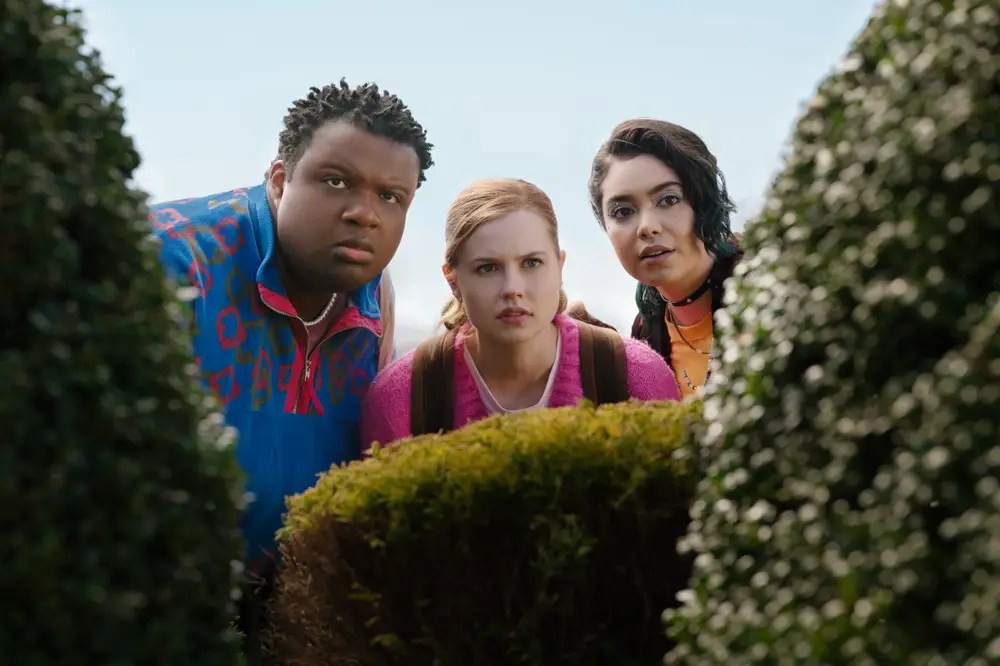
Mean Girls continues the cash-grabbing, anachronistic trend that persists in Hollywood nowadays. And so long as audiences remain receptive, there’s no reason to jettison the business model. As Jason Lee’s character “Brodie” explains to Jay and Silent Bob in the self-effacing movie Jay and Silent Bob Reboot–all one needs to do to be successful with the reboot model is to take the old idea and repackage it with “youth and diversity”. Mean Girls does exactly that, with rewrites of characters previously portrayed by white actors. And the film demonstrates that Tina Fey’s ability to subvert homogeneous narratives through wit and satire remains strong.
However, the main storyline offers nothing new in terms of insight or fresh perspectives. Fans of the 2004 version get appeasement through several meaningful cameos, and the infamous “Burn Book” also makes a notable return. But its appearance serves mostly as a relic of a bygone era, when teenage ridicule and bullying was largely removed from the public sphere. Now social media has fueled such vitriol at an alarming rate; the film depicts this in a few scenes, like one in which the lead mean girl, Regina George (played by Renee Rapp), bumbles her way through a choreographed Christmas performance.
The resulting fallout is that Regina gets blasted on social media as an embarrassment. Meanwhile, the same incident simultaneously elevates the status of Cady Heron (Angourie Rice) from that of a quirky recluse to a full-on diva. That she relies to an extent upon her sexuality to achieve this is also part of the joke. The new film plays with the paradox of teen hyper-sexualization and female empowerment in the same manner as the old one. It’s a foggy message that’s persisted in pop culture for decades, with updated reactions through social media being all the more perplexing. Add to that the layers of diversity and gender identity and you’ve got the makings of a film that’s blissfully diverting while seemingly provocative.
There’s also a backdrop of “unremarkable” characters that serve as proxy to kids in the real world. Amidst the protagonist’s struggle for popularity, there are students of all sizes, colors, and identities that are simply striving for acceptance. The more remarkable idea–interestingly–is the level of diversity among the student body. In the film, this phenomenon seems quite normal (as well it should be). Meanwhile, the reality of public schools is that they appear more homogenous now than they were six decades ago. For all the small-minded pettiness between a group of teen girls, the surrounding setting is far more progressive than many modern schools might hope to be.
How The Reboot Might Offer a Fresh Perspective
The added musical numbers are entertaining, but they don’t carry enough substance to offer more depth to a familiar storyline. Had the producers decided to integrate a fresh take, one could envision a creative infusion of musicality alongside contending with the rise of social media. Such a storyline might include the following elements:
Satirical Characters and Stereotypes:
- Introduce satirical characters that embody exaggerated stereotypes related to bullying, social media, and gender identity.
- Use humor to highlight the absurdity of these stereotypes, encouraging the audience to reflect on the real-world consequences.
Social Media Parodies:
- Incorporate parodies of popular social media platforms, hashtags, and trends to create a humorous commentary on the culture of online bullying.
- Use these parodies to explore the disconnect between online personas and real-life experiences.
Double-Edged Humor:
- Employ double-edged humor that both entertains and prompts reflection.
- Balance lighthearted moments with poignant scenes that reveal the emotional toll of bullying on individuals struggling with their identity.
Empowerment Anthems:
- Integrate empowering musical anthems that celebrate individuality and resilience.
- Use these moments to convey the importance of self-acceptance and embracing one’s unique identity.
Resolution Through Understanding:
- Conclude the production with a resolution that emphasizes understanding, empathy, and positive change.
- Showcase characters who evolve beyond their stereotypes, fostering a sense of belonging based on acceptance and mutual respect.
This new musical version of Mean Girls doesn’t take itself too seriously, thus making it accessible for most audiences. And the incorporation of gender fluidity and identity formation are touchy subjects that feature more prominently without being pushy. With a bit more creativity, these could serve as level-setting talking points for a modern dialogue fraught with hypersensitivity.



 Pop Banter