
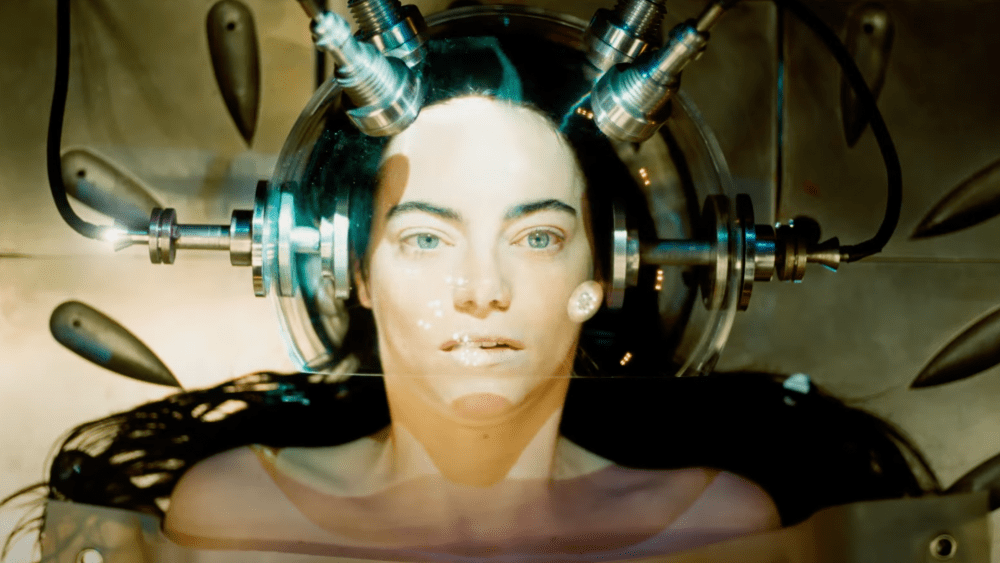
One of the great things about artistic license is the freedom to borrow from timeless concepts like reanimation. Scottish author Alasdair Gray borrowed from the classic narrative of Frankenstein for his novel Poor Things, which daring director Georgios “Yorgos” Lanthimos brought to life on screen in December 2023.
While this narrative is potentially jarring for audiences, the concepts of empowerment and self-discovery shine through. Lanthimos utilizes fantastical visual elements combined with prodigious occurrences to tell the story of Bella Baxter (Emma Stone), a woman reborn from a wild experiment performed by an unhinged scientist (Willem Dafoe).
This film plays with odd juxtapositions that drive the protagonist toward self actualization in provocative ways:
- Intellectual Exploration: Despite her naivete, Bella’s intellectual and creative pursuits emerge through her seafaring journey. She engages in scientific experiments, tracks her experiences, and collaborates with other intellectuals she meets along the way.
- Cultural Exchange: Bella has brief interactions with diverse cultures during her journey. She draws from sobering realities, exchanges knowledge through newfound friendships, like those with Harry Astley (Jerrod Carmichael) and rich divorcee Martha Von Kurtzroc (Hanna Schygulla). Along the way, Bella attempts to contribute to the communities she encounters. This not only emphasizes learning but also highlights the positive aspects of cultural exchange.
- Scientific Discovery: Of course, Bella’s rapidly developing cognition through the film fuels her desire for scientific exploration. Following her creator God, she conducts unorthodox experiments to further her understanding of human anatomy and other scientific phenomena. This approach allows for an exciting and educational storyline alongside potentially compromising ethical boundaries.
- Entrepreneurial Ventures: Bella quickly resorts to sex work, all the while exploring how to increasingly leverage problem-solving intelligence and creativity to fund her expedition. One imagines she might later develop innovative technologies, create art, or contribute to industries in a way that aligns with her newfound abilities. Her choice to resort to sex work seems mostly utilitarian and doesn’t impede her overall resourcefulness.
- Ethical Dilemmas: The concept of neuroanatomy presents darkly humorous ethical dilemmas related to Bella’s eventual transformation. Life isn’t always simple, and her lack of inhibition adds depth to the story as she grapples with the consequences of her choices apart from the supposed moral implications, like her accompanying businessman and sexual deviant Duncan Wedderburn (Mark Ruffalo) on a naval global exploration. Just as real life relationships are complicated, so is Bella’s engagement complicated by her actions.
- Relationship Dynamics: Somewhat astoundingly, Bella eventually returns home to a particularly progressive and open-minded fiancé (played by Ramy Youssef). The film does address the challenges they face and how they navigate issues related to her transformation. Though it emphasizes mutual respect, understanding, and acceptance within the relationship.
- Personal Growth: Undoubtedly, Bella’s “first life” was plagued by trauma as she seemingly endured a controlling husband (Christopher Abbot). In her reanimation, the protagonist’s personal growth becomes clear as she navigates the complexities of her transformed identity. The final act emphasizes her journey towards self-discovery, emotional maturity, and a deeper understanding of her place in the world.
By incorporating these elements, Lanthimos creates a compelling narrative that explores intellectual pursuits, cultural exchange, ethical considerations, and personal growth without resorting to purely exploitative themes. This approach allows for a rich and imaginative story while maintaining a sense of responsibility in storytelling.




 Pop Banter